


On 23 February, DSO Entity published a new report highlighting the growing role of Distribution System Operators (DSOs) in strengthening the resilience of the EU’s energy system in an increasingly decentralised, digitalised and climate-exposed environment.
As Europe’s electricity system undergoes profound transformation, the report shows how DSOs, as the largest integrators of renewable energy sources and decentralised energy resources, are turning into active system operators with an increasing role in system stability, cybersecurity and climate resilience.
From security of supply to an all-hazard resilience approach
Building on the EU’s evolving energy security environment, the report distinguishes between energy security and resilience, emphasising the need for a broader, forward-looking, all-hazard approach shifting away from a pure security-of-supply focus. In this context, resilience is understood as the ability of the energy system to prevent, withstand, adapt to and recover from disruptions, whether caused by extreme weather events, cyberattacks, physical threats or system complexity.
The analysis underlines that distribution grids play a key role not only in maintaining reliable electricity supply in coordination with TSOs, but also in addressing emerging external challenges. DSOs are increasingly exposed to climate-related risks, cybersecurity threats and cascading effects resulting from the integration of renewables, electric vehicles, heat pumps and other decentralised assets.
Key findings:
Based on a survey conducted within DSO Entity’s Country Expert Group, the report demonstrates the growing concerns of DSOs over the critical threats posed by extreme weather events and cyberattacks for the distribution grid resilience across EU Member States and shed light on good practices from European DSOs.
It also highlights the growing role of DSOs in:
- Ensuring system stability in close coordination with TSOs through active system management at distribution level in an increasingly renewable-dominated power system.
- Developing and implementing EU cybersecurity legislation such as the NIS2 Directive, the CER Directive and the Network Code on Cybersecurity.
- Strengthening climate resilience by investing in grid reinforcement and digitalisation and building risk preparedness and emergency scenarios to prevent and react to frequent extreme-weather events and subsequent disruptions via data-driven risk assessment tools.
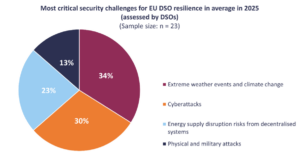
Figure: Most critical security challenges for EU DSO resilience in average in 2025 (assessed by DSOs). Data based on a survey conducted in DSO Entity’s CEG in 2025.
Key recommendations from the Resilience Report
- Need for an adapted and forward-looking regulatory framework:
The report stresses that investments in grid resilience are a non-regret option for Europe’s energy security and decarbonisation objectives. It calls for a forward-looking regulatory framework that supports anticipatory investments, recognises resilience-related costs and ensures predictability for DSOs.
- Effective implementation of existing EU legislation
In a context where the energy security framework is being assessed at the EU level, it is of utmost importance to further ensure effective implementation of existing legislation especially in the fields of cybersecurity and permitting. The adoption of pending regulations also needs to be accelerated (like the Network Code Requirement for Generators 2.0, Network Code on Demand Connection) to enhance resilience and prevent decarbonisation delays.
- Strengthened cooperation through a system-of-systems approach to energy security
Drawing lessons from recent large-scale incidents, the report highlights the need for genuine TSO-DSO cooperation and a stronger involvement of DSOs when assessing pan-European security incidents, to ensure a true system-of-systems approach to resilience
Read the full report here.
Find here the article on Euractiv.
For further information, please contact Claire Vandewalle, Senior Advisor Regulatory Affairs & Strategy (claire.vandewalle@eudsoentity.eu).