

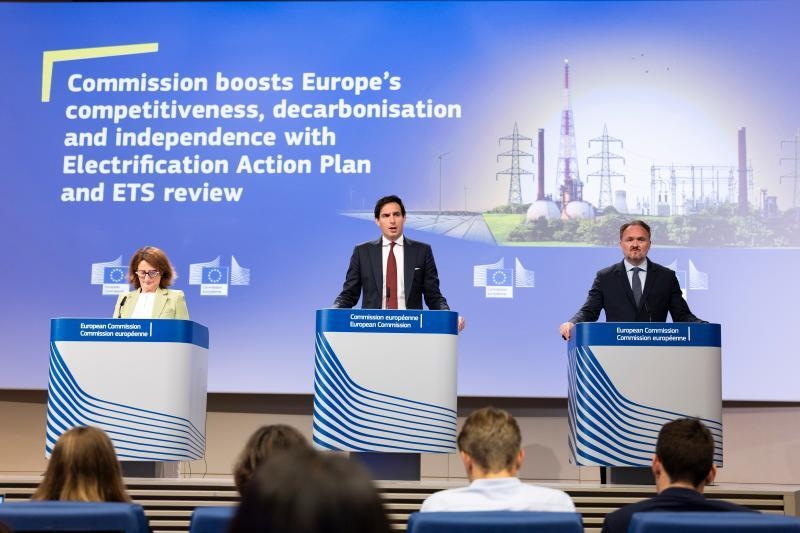
On 17 July 2026, the European Commission (EC) unveiled its Energy Package II designed to accelerate the electrification of Europe’s economy while strengthening competitiveness, resilience and energy security. The package brings together an Electrification Action Plan (EAP), a legislative proposal on future-proofing electricity bills, and a revision of the EU Emissions Trading System (ETS).
The package places a stronger focus on how Europe can make better use of its existing grid infrastructure while continuing to develop the networks needed to support increasing electrification. Mostly relevant for grids are the non-binding provisions in the EAP that sets out the EC’s vision for accelerating electrification across transport, buildings and industry with a new focus on grid productivity; and the legislative proposal on “future-proofing electricity bills” that proposes a reform of the Electricity Market Regulation (2019/943/EU) aimed at lowering electricity costs through higher grid efficiency, digitalisation and electrification.
Grids are core enablers of Europe’s electrification
In its EAP, the EC identifies electrification as “the route” for enhancing Europe’s competitiveness, strengthening security of supply and reducing energy costs, introducing for the first time an indicative EU electrification target of 46% of the final energy consumption by 2040.
It explicitly recognises that electrification cannot progress without stronger, smarter and more efficiently used electricity grids and encourages Member States to boost investment in grids. A lack of grid capacity, connection queues, and the sub-optimal use of existing infrastructure are identified as barriers to connecting new generation to the grid and enabling customers to electrify their energy use. In response, greater emphasis is put on grid optimisation, flexibility, digitalisation, storage, smart network tariffs, anticipatory investment and more efficient network planning.
The EAP builds on the EC’s measures proposed under the Grids Package, the Industrial Accelerator Act as well as ongoing initiatives on permitting, grid planning, grid hosting capacity, connection regimes and demand response. Rather than introducing major new initiatives for grids, the EAP thus brings these strands together within a broader electrification strategy through a new approach turning grid productivity into a new major policy objective.
A strong focus is put on the rollout of electric transport and heat pumps, and skills with several measures announced related to grid connection of charging infrastructure for electric heavy-duty vehicles and ferries in ports, as well as on public procurement notably referring to upcoming initatives like the announced new rules expected for September 2026 and EC’s guidance on NZIA provisions for net-zero technologies. Regarding skills, the EAP mentions that investment in distribution grids alone could sustain 440-620,000 quality local jobs.
Future-proofing electricity bills: Focus on network charges
Alongside the EAP, the EC proposed targeted amendments to the Electricity Market Regulation (EU) 2019/943 through a new legislative proposal on future-proofing electricity bills (COM(2026) 600 final, 2026/0203(COD)). The proposal introduces new rules on network charges design and focuses on stronger regulatory oversight, grid optimisation and digitalisation, while also addressing electricity taxation and grid connections reflecting a growing focus on optimising existing infrastructure alongside continued grid investment needs. Its objective is to improve cost-efficiency of electricity networks, incentivise more efficient use of existing infrastructure and ensure that electricity is taxed more favourably than natural gas.
The legislative proposal sets key principles for the design of network charges aimed at encouraging system operators and network users to optimise the use of existing network capacity. Positive elements include the explicit recognition of capacity-based tariff components, the use of locational investment signals and flexible connection agreements, as well as the incorporation of time of use elements.
Furthermore, the proposal intends to strengthen transparency requirements of tariff methodologies and provide for greater regulatory benchmarking. It calls for the development of performance indicators for efficient network operation, notably for similar comparisons between DSOs to be carried out by National Regulatory Authorities (NRAs) and it empowers the EC to develop EU-wide rules on network tariff structures and methodologies by delegated and implementing acts.
Digitalisation and data sharing are also central to the proposal. NRAs are required to promote smart and digital solutions where they can improve grid capacity, flexibility or reliability. DSO Entity is assigned with a new task together with the EC, ACER, ENTSO-E to develop common Smart Grid Indicators (SGIs) to measure the deployment and performance of digital and smart grid solutions across the EU, supported by TSOs and DSOs data. Furthermore, TSOs and DSOs should participate in a voluntary EU-wide framework to be coordinated by DSO Entity and ENTSO-E to share grid data and develop digital solutions for network operation and optimisation.
Finally, the proposal addresses grid connections in areas facing limited network capacity, including measures concerning grid connection queues, transparent prioritisation criteria, flexible connection agreements, digital technologies and non-wire solutions. It also sets a smart-meter rollout target to ensure a coverage of at least 50% of consumers by 2030 and 75% by 2033 in Member States and restricts the cost-benefit assessment to smart-meter rollout beyond the 75% threshold.
For the next steps, the legislative proposal on future-proofing electricity bills will now proceed with negotiations in the European Parliament and the Council under the ordinary legislative procedure. The Irish Presidency has identified electrification and electricity infrastructure as key priorities, and its final adoption is expected to take place in the first half of 2027.