

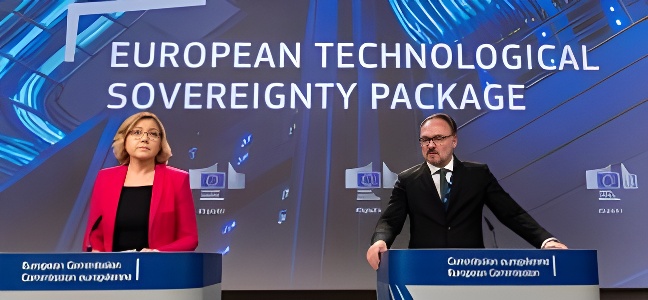
On 3 June 2026, the European Commission (EC) unveiled its Technological Sovereignty Package, aimed at strengthening Europe’s capacity in critical technologies, infrastructure, services and data, reducing dependencies on non-EU technologies. The package includes four initiatives: the Chips Act 2.0, the Cloud and AI Development Act, the EU Open Source Strategy and, most relevant for grids, the Strategic Roadmap for Digitalisation and AI in Energy.
The Strategic Roadmap for Digitalisation and AI in Energy stresses the critical role of grids and is particularly relevant to the electricity sector, providing a framework to accelerate the deployment of digital and AI solutions while addressing the energy needs arising from digitalisation. It is effectively a grid-centric strategy as much as a digital one, focusing on key areas relevant for DSOs, including the integration of data centres, smarter grids, flexibility, and cross-border energy data.
It is organised around three pillars and seven flagship projects, supported by cross-cutting measures on cybersecurity, AI safety, trust, skills, international cooperation, implementation and monitoring.
- Energy for AI: sustainable integration of data centres into the energy system
The growing electricity demand from AI and data centres and their integration into the energy system are addressed by the first pillar which identifies grid as key enablers. In its Roadmap, the EC highlights the need for timely information on data centre developments to support network planning, investment and grid connection processes. The Roadmap also refers to Capacitypedia, platform developed jointly by DSO Entity and ENTSO-E, as a tool to help data centre developers identify locations with available network capacity. It also foresees a model tripartite agreement between data centre operators, energy stakeholders and public authorities to facilitate local coordination. A declaration of intent has been signed, with DSO Entity is among the signatories and an agreement expected in the second half of 2026.
- Deployment of digital and AI solutions across the energy system
The second pillar seeks to accelerate the uptake of digital and AI technologies across the sector, with particular focus on making electricity grids “smarter and stronger’’. The EC stresses the role of smart grids, smart meters and digital and non-wire solutions in making better use of existing network assets and enabling flexibility across demand, generation, storage, heating and mobility. The Roadmap also promotes the development of secure and sovereign AI models across the energy value chain and identifies Horizon Europe as a potential source of funding.
Among the measures announced, the EC foresees an accelerated smart meter rollout as well as the development of EU-level key performance indicators (KPIs) for smart grids. Future recommendations on smart grid indicators are to be issued by ACER to the National Regulatory Authorities (NRAs) in 2026, while NRAs are charged of defining indicators to assess efficient grid operation and the uptake of innovative technologies.
- Data for AI and the energy system: Strengthening interoperability
The data governance and interoperability framework needed to enable digital and AI-based energy services at scale is also addressed under the third pillar. The EC considers cross-border access to energy data essential for developing smarter energy services and AI applications. Although an EU framework already covers primary data use, including metering, billing, switching, demand response and grid operations, its implementation remains uneven across Member States, limiting interoperability. The framework for secondary uses, such as analytics, research and AI training, also remains less developed. To address these challenges, the EC plans to establish an EU framework for simplified energy data exchange, based on common interfaces, harmonised rules and trust services. Work on this is expected to start in 2027 and will cover smart energy services and AI model training.
Further cross-cutting measures
The three pillars are complemented by measures to strengthen the cybersecurity of critical energy devices, including a risk assessment of solar installations in 2026, as well as a review of the energy security of supply framework. The EC also plans to establish a new annual Energy Digitalisation Forum to define metrics for monitoring progress in digitalisation and AI adoption and support improved availability of energy data. A broader initiative on energy data is expected in Q4 2026.