
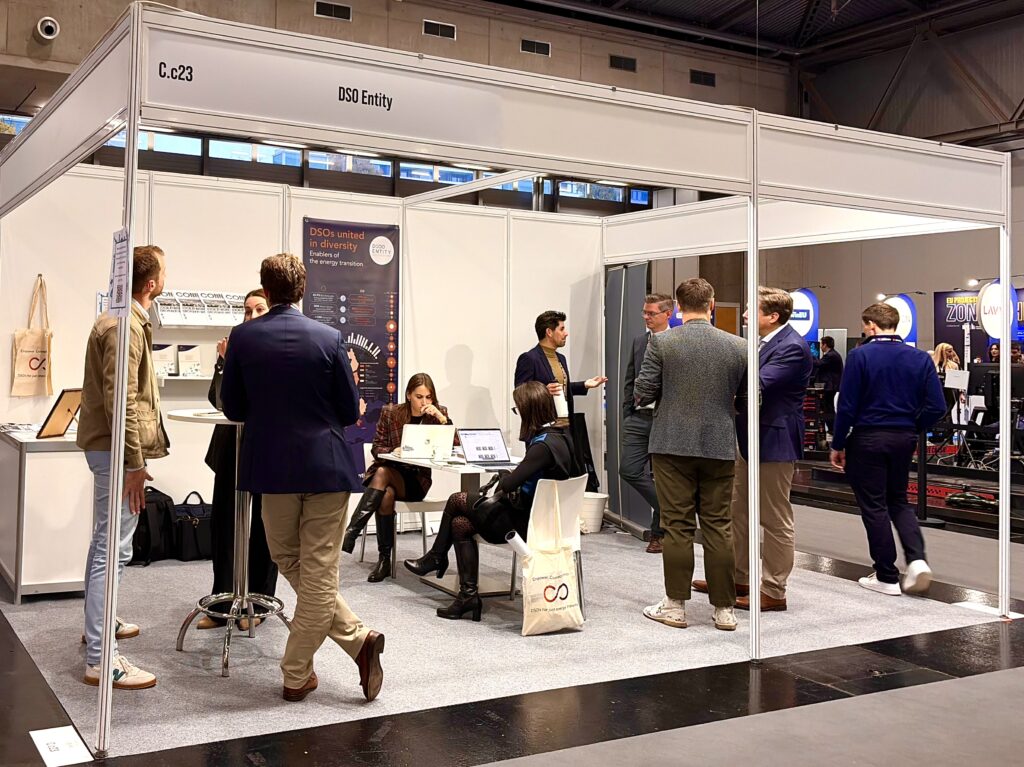
As the energy transition accelerates across Europe, distribution system operators are moving from the background to the centre of the conversation. This year, DSO Entity joined Enlit Europe, bringing its experience of connecting nearly 75 million customers and integrating growing volumes of renewables, electric vehicles and flexible demand into the grid. It was the first public event where the association was represented by both electricity and gas/hydrogen distribution system operators.
DSO Entity’s contributions underline how the future of Europe’s energy system will be decided not only in policy rooms but also in the local grids where change is already happening. Integration, resilience, AND competitiveness were among the recurrent keywords across the event.
The European regulation, gas and grid technology
At the Summit, Secretary General, Peter Vermaat addressed the main priorities of the Grids Package for DSOs and the practical measures needed to speed up grid delivery, from fairer connection queues to stronger coordination across Europe. He stressed the need for the right balance between bottom-up and top-down planning, with a key role for national iterations between DSOs and TSOs.
Board member Raúl Suárez (Nedgia – Grupo Naturgy), joined a panel on gas, the first intervention on the topic since the organisation’s recent enlargement to gas and hydrogen DSOs. For Europe to deliver a secure, affordable and decarbonised energy system, an integrated system fully using both electricity and gas networks is needed. Gas DSOs, he said, have a pivotal role in bringing renewable gases such as biomethane to scale. The energy transition is not a choice between electrons and molecules but about making them work smarter together. By unlocking renewable gases, Europe can turn existing infrastructure into an enabler of decarbonisation while keeping the system affordable, resilient and secure.
Secretary General, Gabrielle Gauthey, (GD4S) used the session on monetising flexibility and stability in low-inertia systems to discuss the role gas must play beside renewable electricity. Flexibility should be rewarded according to the value it delivers to the system, from reducing peak demand to avoiding new investment.
In the Hub Session, member of Task Force DESAP, Ádám Tóth (E.ON Hungária), presented the latest developments of Technopedia, the knowledge-sharing platform on grid technologies and use cases for distribution and transmission system operators, which is open for stakeholder support.
Flexibility and Data Interoperability take centre stage, creating a live platform for expertise with stakeholders
DSO Entity brought its working method to Vienna. The Expert Group on Distributed Flexibility (EG DF) held its regular meeting at Enlit and opened the agenda to stakeholders, creating space for dialogue on the workstreams shaping its work. Discussions covered its coordination role in the Flexibility Needs Assessment process, markets for local services and DSO examples of flexible connection agreements. The session closed with a live demonstration of Capacitypedia, a joint initiative to build a pan-EU overview of publicly available grid hosting capacity.
Chair of EG DF, Torsten Knop, joined a panel that assessed where demand-side flexibility stands today for distribution grids. Looking ahead, panelists were united in their view that cooperation, collaboration and trust among all parties will be essential to keeping the network working.
In “Using Flexibility to Optimise Grid Investment”, member of EG DF, Hubert Dupin, examined how DSOs can use flexibility to make better use of existing grid capacity. Turning flexibility into an effective grid resource, will in fact require a profound transformation inside DSOs themselves.
Chair of Expert Group Data Interoperability (EG DI), Paul de Wit, outlined how DSO Entity is supporting the European Commission on data interoperability legislation, including the implementing regulations on Demand Response and Customer Switching.
Grid Investments, Sector Coupling and Competitiveness
In the panel discussion on “Electrification, Gas and Industrial Competitiveness”, Chair of Task Force Finance (TF FIN), Yago Ramos Sánchez (EDP), highlighted that the real threat to affordability and competitiveness is not grid investment itself, but a grid that arrives too late. With distribution networks accounting for many grid investment needs and projects often requiring years of planning and implementation, DSOs must be able to make anticipatory investments and add capacity ahead of demand. Clear connection rules, regulatory certainty and predictable financing conditions are essential to give network operators the confidence needed to support electrification, industrial competitiveness and the wider energy transition.
_______________________________________________
Read our article on the gas integration: DSO Entity completed the integration of Gas/H2 DSOs into its existing structure.
For more information and cooperation on external events, please contact Stefania Facco (stefania.facco@eudsoentity.eu). Learn more about our work here.