Over the past decade, the European energy system has evolved towards a more interconnected yet increasingly decentralised model, in which cooperation has become crucial. The creation of DSO Entity in 2021 acknowledges the growing importance of the decentralised level, with DSOs at its core.
On 25 June, DSO Entity held its Annual Conference, which also marked the 5th Anniversary of the activities. Over its first five years, DSO Entity has been a key partner in shaping this emerging system of systems – local and national in governance, yet European and interconnected.
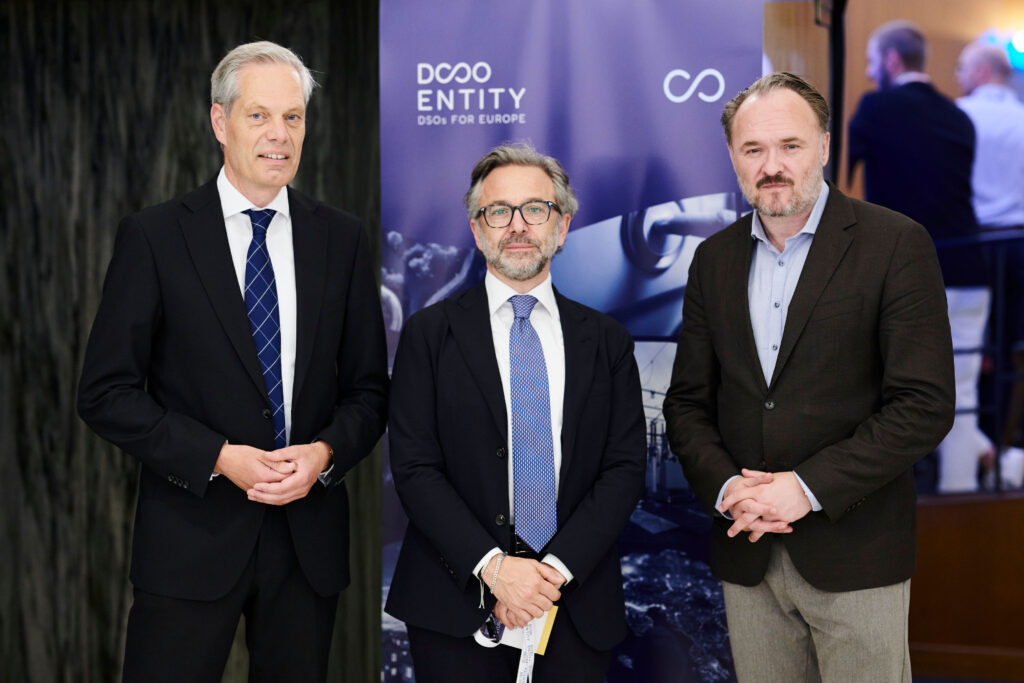
Dan Jørgensen, Commissioner for Energy and Housing, opened the event congratulating DSO Entity on 5 years of expertise and engagement and calling for a lasting collaboration. He highlighted the importance of DSOs and their ability to connect and support the life of European citizens. In fact, DSOs are facing great challenges, but also opportunities to use infrastructures efficiently.
He outlined the European Commission’s initiatives that play a key role in helping DSOs, such as the Grid Package, the Clean Investment Strategy, and the upcoming Electrification Action Plan. According to Jørgensen: “together, we bring power to consumers, and we build a common European project for a true Energy Union with home-grown energy.”
Then, President Vincenzo Ranieri, looked back at the very beginning of DSO Entity and recalled how its foundations were laid with the invaluable support and vision of the European Institutions, taking a moment to express sincere and formal appreciation to the European Commission, the European Parliament, EU Agency for the Cooperation of Energy Regulators (ACER), and all the institutions that have accompanied us throughout our journey.
He also stressed how we brought together hundreds of experts from across Europe who have worked side by side to develop our common Technical Vision, helping us share knowledge and defining a framework capable of reflecting different levels of maturity while supporting a shared mission. He then paid tribute to the General Assembly, the DSO associations, the Board of Directors, and the Secretariat, whose dedication, expertise, and continuous support have played an important role in shaping DSO Entity and supporting its development over the past five years.
Vincenzo closed his speech with a forward-looking perspective: the upcoming years will be years of delivery: “Europe’s energy future will not be shaped only by large objectives or high-level strategies. It will also depend on our ability to translate those ambitions into reality, reaching homes, businesses, industries, communities and territories“.
Moderated by Peter Vermaat (Secretary General, DSO Entity), we then started Panel I, focusing on the necessity to establish DSO Entity as an institutional platform, focusing on the results achieved so far and the learnings for future steps thanks to the three mini-interviews we held on to stage.
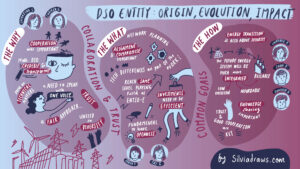
THE WHY – BEFORE DSO ENTITY
Together with Catharina Sikow-Magny (Professor at FSR and former Director at DG ENER) and Carmen Gimeno (Secretary General at GEODE), we discussed the changing energy system and EU policies with the need for the creation of DSO Entity, reflecting on the needs behind the creation of a unified entity that could put the members and DSOs at its centre, linking it with a changing energy system and recent EU policy developments. As Sikow-Magny mentioned, “Much has been achieved since 2021; further advice, now, would be to enhance the role of DSOs in the integrated planning for grids and in the financing side.”
THE HOW – IMPLEMENTATION AND CHANGED WAY OF WORKING FOR OTHER
Together with Sonya Twohig (Secretary General, ENTSO-E) and Fay Geitona (Deputy Head for Energy System Needs, ACER), we discussed the way of working of the organisation, the strong institutional partnerships in place and how the perception of the work changed throughout the years and its effects. The speakers recalled how the creation of DSO Entity was facilitated and perceived by the two organisations, describing the way that led to today’s relation. A clear example of cooperation with ENTSO-E was the Memorandum of Understanding, which then evolved every year in a joint work programme, putting on the ground the technical expertise of DSOs and TSOs members, working side-by-side for common objectives. From ACER perspective, the Flexibility Needs Assessment (FNA) was added as an illustration of the joint learning curve and the first-time effort for a system-wide view on flexibility.
THE WHAT – IMPACT AND OUTCOME
Together with European Commission’s representative Joachim Balke (Title, DG ENER), the gas representative Laurence Poirier-Dietz (CEO, GRDF), and Jana Palkova (DSO Entity Board Member) we discussed the achievements and value created, with an eye to the gas/H2 integration, which has just been finalised with the approval of the General Assembly. Poirier-Dietz, a member of one of the new gas associations joining DSO Entity, explored how integrating into an existing association reflects the way the energy system in Europe itself is evolving. What we have seen in the past few years in the geopolitical landscape reminded us how energy is key: “As DSOs, our responsibility in the system is crucial, because we are no longer simply operating network but providing the energy system needed for the future. Palkova then gave a broader overview, looking at her dual position in the organisation, stressing on the values and benefits, including not only the importance of DSO Entity’s technical work but also the importance of working on the pillar of knowledge sharing. Lastly, Balke wrapped up on the panel with the European Commission’s point of view, since the biggest challenge for institutions – when doing legislation and recommendations – is to understand what it means on the ground in 27 Member States. This is where the Commission needs DSO Entity’s experts: “where cooperation and work with our experts bring the full measures – everyone should work on making sure we understand the impact and have the expertise in the full geography we cover”.