


On 12 February, DSO Entity launched its report “Distributed Flexibility Practices – Market for Local Services”, which provides a comprehensive overview of current practices in participating DSOs, highlighting lessons learned from pilots and existing flexibility mechanisms.
Participating DSOs from France, Italy, the Netherlands, Portugal, Sweden, and Norway, have successfully combined flexibility, grid reinforcement, tariffs, and rules-based measures to address congestion and voltage issues. This report acts as a foundation for knowledge sharing, learning, and preparedness for implementing regulated local flexibility markets.
Background information
Europe’s electricity distribution networks are evolving rapidly due to growing renewable generation, electrification of industry, and new flexible loads such as heat pumps and EV charging. In this context, distributed flexibility and markets for local services have proven effective tools for managing congestion and voltage issues and connecting new customers.
Evidence from advanced Member States shows that DSOs are already using flexibility, often alongside grid reinforcement, tariffs, FCAs and rules-based measures, to manage congestion, maintain service quality, and integrate new connections efficiently.
DSO Entity’s Technical Vision: DSO’s Role as Market Facilitators
DSOs are increasingly acting as market facilitators, enabling distributed resources to provide flexibility services alongside their regulated duties. As local grid challenges are highly locational and time-specific, tailored flexibility products, in addition to proportionate qualification, and realistic activation processes are essential to complement transmission-level balancing products.
By operationalising markets for local services, DSOs reinforce their central role in local energy ecosystems, alleviating pressure on grid reinforcement needs, and contributing to a secure and efficient European electricity system.
Effectiveness of markets for local services depends on standardised digitalisation and close coordination between DSOs, TSOs, markets, and neighboring system operators. Ultimately, NC DR framework and national implementation choices will determine whether flexibility becomes a reliable and cost-efficient tool for distribution system operation.
Recommendations & Critical Regulatory Actions
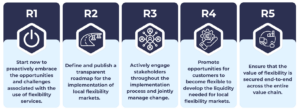
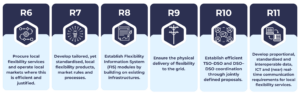
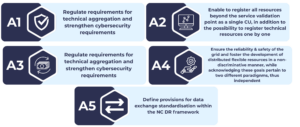
This report sets out 11 key recommendations and 5 critical regulatory actions aimed at supporting the development of effective local flexibility markets. Together, they provide a practical and pragmatic, DSO-driven framework to guide market development and to translate the Network Code on Demand Response (NC DR) into workable national terms and conditions (NTCs) that reflect the realities and needs of distribution grids.
Read the Report here
For more information, please contact Mehtap Alper mehtap.alper@eudsoentity.eu and Valeria Battista valeria.battista@eudsoentity.eu