

When DSO Entity launched its Technical Vision in December 2024, the goal was clear: establish a unified framework and common language among Europe’s Distribution System Operators (DSOs) to guide the need of a more integrated, customer-centered, and future-proof electricity system. The Technical Vision set out not only to ensure reliability, affordability, and sustainability for European citizens, but also to enhance the competitiveness of Europe’s energy industry.
DSOs have long been committed to expanding and modernising their networks in line with Europe’s evolving energy needs. The Technical Vision built on these strengths, identifying core development areas where DSOs can deliver value for customers, markets, and society.
Most importantly, the Technical Vision creates alignment, not only among DSOs, but with TSOs, regulators, and EU institutions. It gives us a platform to speak with one voice from DSO Entity on what the system needs, what investments are essential, and how we must adapt to climate, digital, and security pressures.
“One year on, the progress made shows the value of having this shared compass. It has helped us build the foundations of a more dynamic, flexible, and future-ready grids for Europe.” Says Vincenzo Ranieri, President of DSO Entity.
Under the overall objective of serving the customer by enabling a just energy transition, all five areas were elaborated:
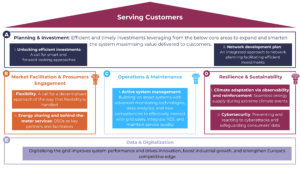
Planning & Investments
The Technical Vision provided a clear roadmap: planning and investment are central pillars for a resilient, customer-centric energy system. It calls for anticipatory, data-driven investments and closer cooperation with TSOs to avoid bottlenecks and enable flexibility. Investment needs in Europe’s electricity distribution grids are rising rapidly as electrification accelerates.
In 2025, DSO Entity strengthened this vision by strengthening the Planning & Investments pillar. A unified Flexibility Needs Assessment approach was introduced, enabling DSOs to consistently identify future grid constraints and evaluate flexibility as a strategic alternative to traditional reinforcement. This established flexibility as a strategic component of Europe’s long-term grid development.
Anticipatory investments emerged as DSO Entity’s flagship topic for the year. These investments—made ahead of demand—are essential to reducing long-term system costs and accelerating decarbonisation. DSO Entity also worked to identify more effective regulatory and financing models, risk-sharing mechanisms, and methodologies for blending EU funds with private capital. The objective: ensure all DSOs, regardless of size or geography, can access the financing needed to build the infrastructure Europe requires.
“Anticipatory investments are essential to prevent grid constraints from slowing Europe’s decarbonization. Our work is about creating financial frameworks that enable DSOs to act now” says Oliver Franz, Vice Chair of TF FIN.
With rising electrification, the growth of data centers and the rapid deployment of battery storage, DSOs’ ability to secure and deploy capital efficiently will be critical to Europe’s success in reaching climate neutrality.
Market Facilitation & Prosumer Engagement
Throughout 2025, DSO Entity consolidated the strategic role of flexibility in the European power system. By engaging closely with ACER and the European Commission, DSO Entity ensured that DSOs’ operational insights directly informed the development of the Demand Response Network Code. This helped ensure that future European rules reflect real-world distribution-level needs, such as congestion management and grid visibility. Beyond regulatory work, DSO Entity advanced several practical measures to facilitate well-functioning flexibility markets. It supported the development of the Implementing Regulation on Demand Response by providing technical input on standardized data-exhange, interoperability, and coordination procedures that will shape market entry conditions for service providers and demand-side participants across Europe.
DSO Entity also championed harmonised, non-discriminatory access to grid and operational data, enabling market participants to identify flexibility opportunities better.
“Our goal is simple: build a sound foundation for flexibility markets transparent, well-functioning, and open to all. By establishing standardized information exchange and coordination rules, we’re laying the foundations for a truly competitive European flexibility ecosystem.” Says Yvonne Ruwaida, Vice Chair of EG DF
Resilience & Climate adaptation
In 2025, DSO Entity and ENTSO-E, working closely with ACER, delivered two major cybersecurity milestones that translate the Technical Vision’s ambitions for resilience into operational reality.
The new Cyber-Attack Classification Scale (CACS), introduces a harmonised, system-wide approach for identifying, categorising, and escalating cyber incidents across all Member State DSOs. By creating a sharing operational language and well-defined severity thresholds, CACS enhances situational awareness and underpins faster, more coherent responses—particularly in cross-border or multi-system events where coordination is critical.
Secondly, the Cybersecurity Risk Assessment Methodologies provide a structured and forward-looking approach for identifying critical grid functions, assessing vulnerabilities, and quantifying the potential impact of cyber failures. Together, those tools help DSOs and TSOs prioritise mitigation measures, reinforce cyber-defense strategies, and converge towards a consistent resilience posture across Europe.
These two methodologies form a long-term foundation for cybersecurity governance and ensure that Europe’s electricity system can withstand growing digital-era risks.
In addition, anticipatory investments became a key resilience lever in 2025. Rather than reacting only to consumer-driven demand, DSO Entity highlighted the need to reinforce and modernise the grid ahead of climate pressures and emerging system risks. By upgrading vulnerable assets early and integrating flexible, digital-ready solutions, DSOs can strengthen the network’s ability to withstand extreme weather, rising electrification, and cyber-physical threats. This proactive investment approach complements the new cybersecurity tools and helps anchor a coherent, long-term resilience framework for Europe’s electricity system.
Data & Digitalisation
The digital transformation of Europe’s distribution grids accelerated in 2025, particularly through the development of the new Implementing Regulation on Demand Response. The Regulation introduces harmonised data models, interfaces, and access procedures, helping build a fully interoperable digital infrastructure across Member States.
These advancements strengthen the role of DSOs as neutral data hubs – enabling secure, real-time exchange of metering and operational information and providing the consistency required for scaling demand response. These advancements lay the groundwork for seamless participation by consumers, aggregators, and distributed resources—an essential condition for a truly digital and flexible electricity system.
Key digital tools developed under the Technical Vision also matured this year:
– Technopedia, which harmonizes technology definitions and functional capabilities across Europe, strengthening interoperability and accelerating the adoption of advanced digital tools for system operation
– Capacitypedia, which provides comparable and transparent hosting capacity information, supporting planners, policymakers and market actors in identifying investment and flexibility opportunities, while giving market actors, planners, and policymakers a reliable, comparable view of available network capacity.
– Data repository platform, which provides a central access point for stakeholders to explore how Member States are implementing the EU reference model for data access.
Together, these platforms enhance a unified digital ecosystem that improves visibility, supports better planning decisions, and helps unlock new flexibility and investment opportunities across Europe’s distribution grids.
Operations and maintenance for Active system operators
As Europe’s grids become more decentralised and dynamic, DSOs are evolving into Active System Operators with advanced capabilities to manage new challenges.
A major 2025 milestone was the delivery of the Grid-Forming Capabilities Assessment, which provides a common framework for evaluating how inverter-based resources—such as batteries, solar PV, and hybrid systems—can support system stability. This work clarifies performance expectations, identifies integration challenges at distribution level, and helps DSOs plan for a future where distributed energy resources play an active role in maintaining system strength.
DSO Entity also played an important role in supporting ENTSO-E’s Expert Panel investigating the Iberian Peninsula incident. By providing DSO-specific data, operational insights, and contextual information on distribution-level behavior, DSO Entity contributed to the analysis, which captured the full system perspective—highlighting how distribution-connected generation, protection schemes, and local control actions can influence overall system stability during major events. This collaboration reinforced the importance of coordinated operations across all voltage levels.
Together, these initiatives operationalise the Technical Vision for Active System Operators – equipping DSOs with the tools, practices, and shared understanding needed to maintain stability, integrate new technologies and enhance resilience.
None of the achievements and developments of the Technical Vision would have been possible without the dedication of DSO Entity’s expert community and the increased cooperation with ENTSO-E, European Commission and ACER. This collaboration is essential to ensure that Europe’s regulatory frameworks evolve in step with the needs of a decarbonised, digitalised and decentralised energy system.
As DSO Entity moves into 2026, the foundations laid this year will support the continued transformation of Europe’s electricity distribution networks, ensuring they remain resilient, flexible and ready to deliver on Europe’s energy transition.