During our 5th Anniversary event last 25 June, we retraced our journey since the beginning of our activities in 2021, emphasising how DSOs are central to achieving the European Union’s sustainability objectives, to empowering consumers and to supporting a competitive economy (read more on the first panel here).
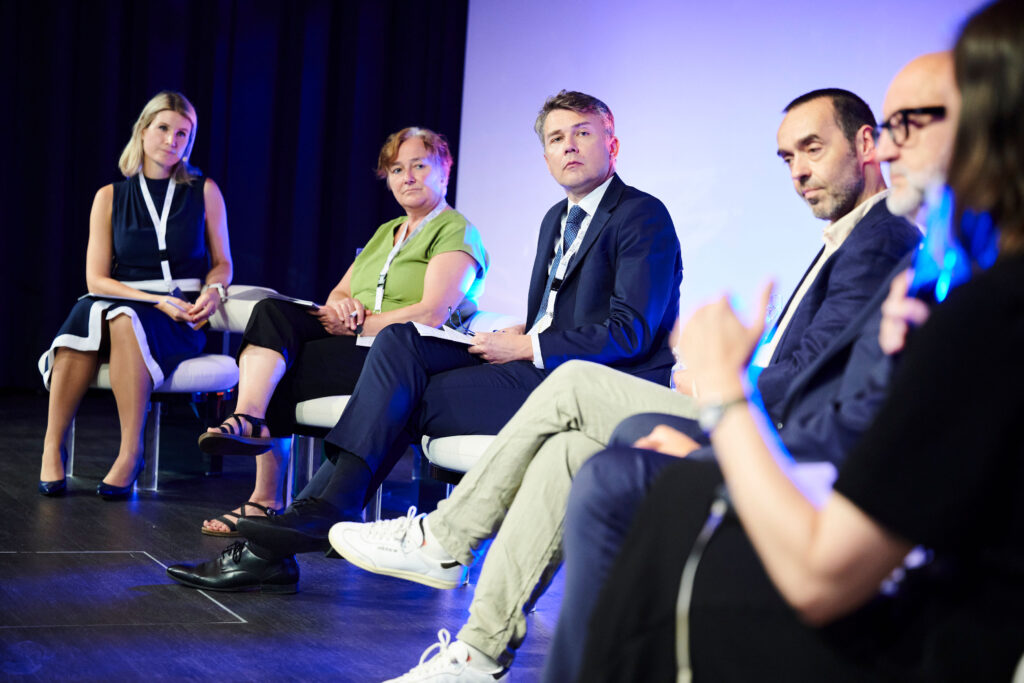
With Elisa Van Dooren’s (Team lead Strategy, Legal & Regulatory Affairs, DSO Entity), moderation we explored challenges and solutions to deliver the grids needed for a decarbonised, competitive and resilient energy system.
Elisa framed the discussion describing the current context as one of multiple overlapping challenges, highlighting that DSOs are at the center of Europe’s response. Indeed, although DSOs operate at a local level, their role is increasingly European in scope, shaping the transformation of the wider energy system.
The insights from policymakers, DSOs, industry, and technology providers shed light on how Europe can create the right framework to effectively support DSOs in accelerating grid connections while ensuring a rapid and cost-efficient grid build-out and strengthening Europe’s competitiveness.
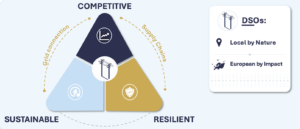
Figure: DSOs in the middle of the EU’s energy trilemma (Source: DSO Entity, 2026)
Grid connections: from bottleneck to opportunity
Providing a practical perspective from the ground, Erwin Smole (DSO Entity’s Board Director and Managing Director, Stadtwerke Klagenfurt), illustrated how fast electricity demand is evolving by providing concrete examples from his utility. The pace and the magnitude of the changes demonstrate that DSOs are not merely responding to the energy transition but are actively driving it. At the same time, such developments highlight the increasing scale and complexity of projects, reinforcing the need for realistic planning timelines and efficient permitting procedures.
Łukasz Kolinski (Director for Green Transition and Energy System Integration, European Commission) brought a more institutional perspective, explaining how the Grids Package seeks to improve planning, accelerate permitting and grid build-out, and make better use of existing infrastructure. He also referred to the EC’ guidelines on timely and effective grid connections, and to further initiatives, including the forthcoming Electrification Action Plan and the legislative proposal on network charges and taxation, expected to be published on 15 July.
The discussion in the European Parliament reflects a similar sense of urgency. In fact, Bruno Tobback (Member of the European Parliament) argued that Europe should see grid development as one of its greatest economic opportunities as a driver of future competitiveness rather than a crisis. He called for clearer and more predictable rules for managing grid connections, including the possibility of moving beyond purely chronological connection queues, and greater certainty for investors through predictable electricity prices and network charges.
Adèle Naudy-Chambaud (Vice President for EU Government Affairs, Schneider Electric) echoed this optimistic approach “The technologies are already available,” she stated, but the challenge now lies in deploying them at scale. According to her, digitalising electricity networks and scaling up flexibility solutions, energy management systems, smart buildings and self-consumption can unlock grid capacity and reduce pressure on infrastructure.
Representing Europe’s energy-intensive industries, Isabelle Chaput (Secretary General, IFIEC), underlined that timely grid connections have become increasingly important as new electricity-intensive customers, including data centers, compete for access to the network. Grids are only one component of overall energy costs and she warned that rising infrastructure costs could undermine industrial competitiveness. Achieving the right balance between energy security, sustainability and affordability,requires efficient network operation, cost-effective investments, and close cooperation across the energy system.
Supply chains, strategic autonomy and Europe’s industrial future
The conversation then shifted to another decarbonisation’s challenge looking into how to ensure resilient and strong supply chains for grid equipment and technologies.
Drawing once again on operational experience, Erwin Smole explained that transformers and cables remain among the most challenging components to procure, although his utility has strengthened its resilience by maintaining strategic cable stocks following the lessons learned during the COVID-19 pandemic. Beyond procurement itself, he noted that increasingly complex planning procedures have become an equally significant challenge.
From the EC’s perspective, Łukasz Kolinski acknowledged that reconciling rapid grid deployment with Europe’s growing ambitions on industrial competitiveness and strategic autonomy requires a careful balance. Supporting European manufacturing while accelerating grid deployment requires greater visibility on future grid investment needs, allowing manufacturers to plan capacity and scale production accordingly. In this respect, he referred to DSO Entity’s initiative to provide information on Distribution Network Development Plans through a dedicated platform as a positive development. He also pointed to further standardisation of grid equipment, smarter tendering, the availability of skilled workers, and access to financing, including through instruments such as the European Investment Bank (EIB), as key measures.
Building on these points, MEP Bruno Tobback added that Europe must become far more anticipatory in its planning. Developing common European scenarios for electrification and grid reinforcement would provide greater certainty for both network operators and manufacturers. At the same time, he suggested that European standards can themselves become a strategic advantage, supporting domestic industry and strengthening the resilience of critical energy infrastructure at once in an increasingly uncertain geopolitical environment.
Drawing on Schneider Electric’s European manufacturing footprint, Adèle Naudy-Chambaud highlighted that scaling up production depends not only on expanding industrial capacity, but also on secure access to critical raw materials, a sufficiently skilled workforce and, above all, clear and predictable regulatory framework that provide long-term investment certainty.
From the industrial consumers’ perspective, Isabelle Chaput welcomed the growing political attention given to infrastructure but stressed that industry must be more closely involved in planning processes. Europe’s competitiveness, she stated, depends not only on electricity networks, but on coordinated development across electricity, gas, hydrogen and CO₂ infrastructure.
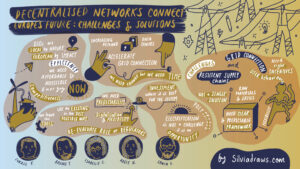
From discussion to delivery: a shared objective
Despite approaching the debate from different perspectives, participants converged on one central message: Europe’s decarbonisation challenge is no longer primarily about identifying solutions, but about implementing them at the necessary pace and scale. Whether through quicker permitting, smarter use of existing grids, stronger European manufacturing industry or more predictable regulation, DSOs must be recognised as strategic infrastructure underpinning Europe’s competitiveness, security and decarbonisation. As DSO Entity celebrated its 5th anniversary, the discussion demonstrated that continued dialogue between policymakers, network operators and industry will be essential to turn ambition into implementation.
Award ceremony
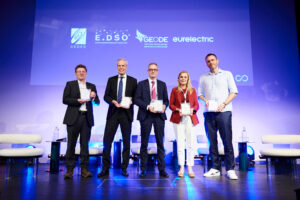
Following the panel, we also had a small celebratory moment to commemorate the good cooperation and achievements of DSO Entity with the four DSO associations operating in Brussels.
Carmen Gimeno, Secretary General of GEODE; Gert De Block, Secretary General of CEDEC; Remy Garaude Verdier (on behalf of Charles Esser) E.DSO; and Kristian Ruby, Secretary General of Eurelectric, joined Peter Vermaat on stage to receive a little commemorative plaque for their commitment and cooperation in supporting the creation of DSO Entity between 2020 and 2021, when the European Commission flagged the need for an entity where all voices of DSOs could be heard.